
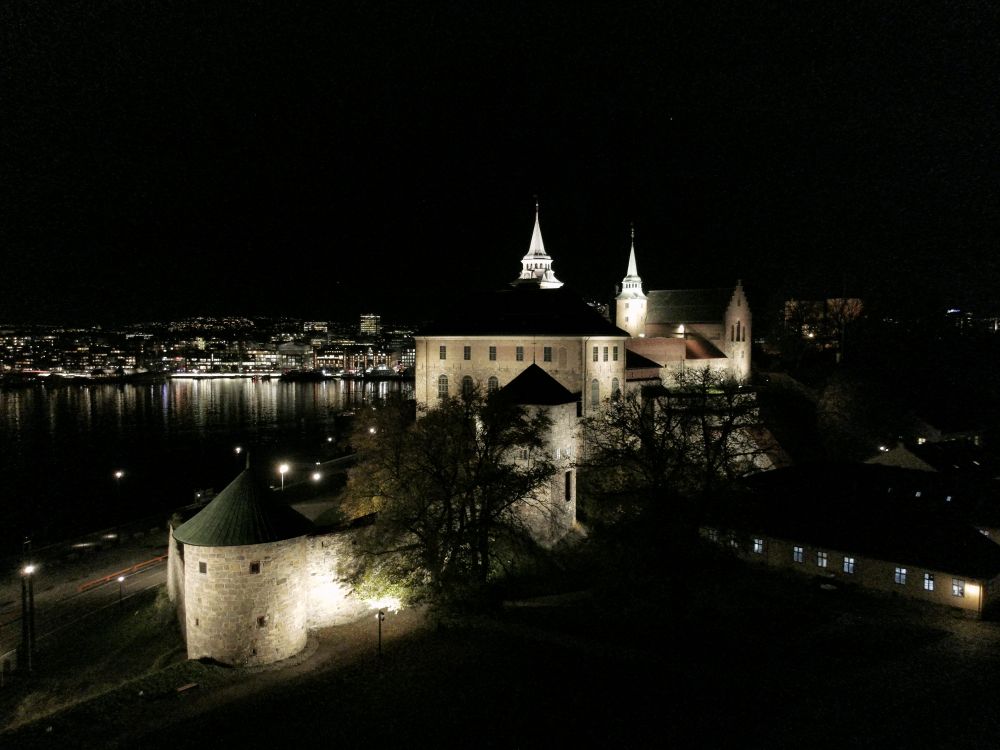
A lighting modernisation project for one of Norway’s most important historical landmarks has been completed using a suite of solutions from Pharos Architectural Controls.
Akershus Fortress is located in the centre of the Norwegian capital of Oslo and was built in the 13th century. It has served as both a royal residence and a military facility. Today, the grounds are open to the public, and this green space is a popular spot for recreation and leisure in the city. The fortress offers a unique historical environment, cultural experiences and a landmark to attract domestic and international visitors.
During the hours of darkness, Akershus Fortress is illuminated to enhance the city’s visual appeal for residents and visitors. With the lighting system becoming outdated and inefficient, owners of the site, Forsvarsbygg (The Norwegian Defence Estates Agency) recognised the need for a modernisation project. Scandinavian lighting design practice Zenisk was appointed to create the contemporary lighting scheme, and LYSKONTROLL AS was appointed to implement the lighting control system.
With their strong understanding of Pharos technology and its capabilities, LYSKONTROLL were the perfect choice for this task. They not only had extensive experience with large, complex DMX and DALI installations, but were able to bring their expertise in delivering demanding, high-precision solutions to the table.
The overhaul of the exterior lighting system needed to address a number of critical needs such as replacing outdated and inefficient lighting infrastructure, improving sustainability through energy-efficient LED technology, and enhancing visibility, safety, and aesthetic presence at night.
Focusing on environmental issues, the new lighting also needed to reduce light pollution, which was particularly important given the fortress’ elevated position above Oslo. Closely linked to this, the illumination had to minimise any negative impact on local flora and fauna, ensuring that the lighting respects natural rhythms and avoids unnecessary disturbance.
The lighting project covered a large area across the fortress, which presented significant logistical and technical challenges. As it was not possible to install conventional cabling across the site, the entire control system, including all communication between controllers and luminaires, was designed to operate completely wirelessly.
LYSKONTROLL specified and commissioned a system from Pharos to deliver the lighting control element of the upgrade works, with two Pharos Designer LPC controllers at the heart of the installation acting as the main control engines for all architectural scenes, dynamic timelines, triggers, and logic sequences. Using two LPC units provides both redundancy and distributed processing power, ensuring reliable operation across the fortress’ extensive lighting layout.
To deliver distributed DALI control across the fortress, the system incorporates multiple Pharos Designer RIO D4 devices to provide distributed DALI control for the luminaires, while simplifying installation and enabling precise local control across various locations.
Because traditional cabling was not viable in the heritage environment, all five DALI subnets operate fully wirelessly using LumenRadio W-DALI. This solution minimises physical impact on the historic structures while providing robust and reliable wireless performance. The wireless architecture also ensures long-term scalability, allowing additional subnets to be added in future phases of the project.
Pharos Cloud adds another essential layer of capability, providing secure remote access for monitoring, management, and troubleshooting. From anywhere in the world, operators can oversee system health and performance. This remote functionality significantly reduces the need for on-site intervention while supporting smooth daily operation.
Local control was also a priority for staff working within the restaurant and castle areas of the site. Custom interfaces allow employees to easily select and adjust lighting scenes, providing flexibility for both day-to-day use and special events including national celebrations – without compromising the centralised Pharos programming.
Together, the Designer LPCs, Designer RIO D4s, and Cloud platform – combined with LumenRadio’s wireless DALI technology – create a flexible, networked, low-latency system capable of smooth and synchronised lighting sequences. This operates over 232 luminaires installed across more than 50 positions. The system also provides local control for both the castle and the on-site restaurant to adjust settings as needed.
Zenisk developed both the lighting concept and the detailed design for the new façade illumination. The solution was created in close collaboration with cultural heritage and conservation authorities to ensure minimal physical and visual impact on the historic structures. Extensive mock-ups, lighting tests, and on-site focusing were carried out to achieve a precise and balanced scheme that enhances the textures of the stone façades and castle walls without overwhelming them.
Ryan Sainsbury, Regional Sales Manager for UK, Ireland, N. Europe and Benelux at Pharos Architectural Controls, said: “The Akershus Fortress project demonstrates how modern technology can work in harmony with history to elevate its presence for today’s generations. Now, the landmark can be celebrated throughout seasons and ensure that its stories can be communicated for years to come, and without negatively impacting the surrounding environment or species that inhabit it”
Geir Sire, owner of LYSKONTROLL AS, added: “Akershus Fortress is an important site in Norway, yet the lighting was not showcasing its architecture. It was also inflexible and did not allow for local control and adaptability. The technology from Pharos was exactly what was needed – a fully wireless system, that is aiding improved energy efficiency and therefore sustainability, and providing that all-important control for the teams working at the site.”
The result is a system that respects the site’s history while enabling sophisticated architectural and ceremonial illumination, delivering a visually unified, low-latency, and future-ready lighting experience. The project forms part of a broader strategy to strengthen the fortress’ role as an accessible and appealing cultural destination, while protecting the environment and maintaining the historical integrity of the site.
Project Credits
Client: Forsvarsbygg
Lighting Design: Zenisk, Project Manager Stian Lindquist
Lighting Product Supplier: SML Lighting (Selux, BEGA) – Tore Nistad
System Integrator & Programmer: LYSKONTROLL AS – Geir Sire
Installer: Installatøren Oslo AS
Photography and Video: Forsvarsbygg