
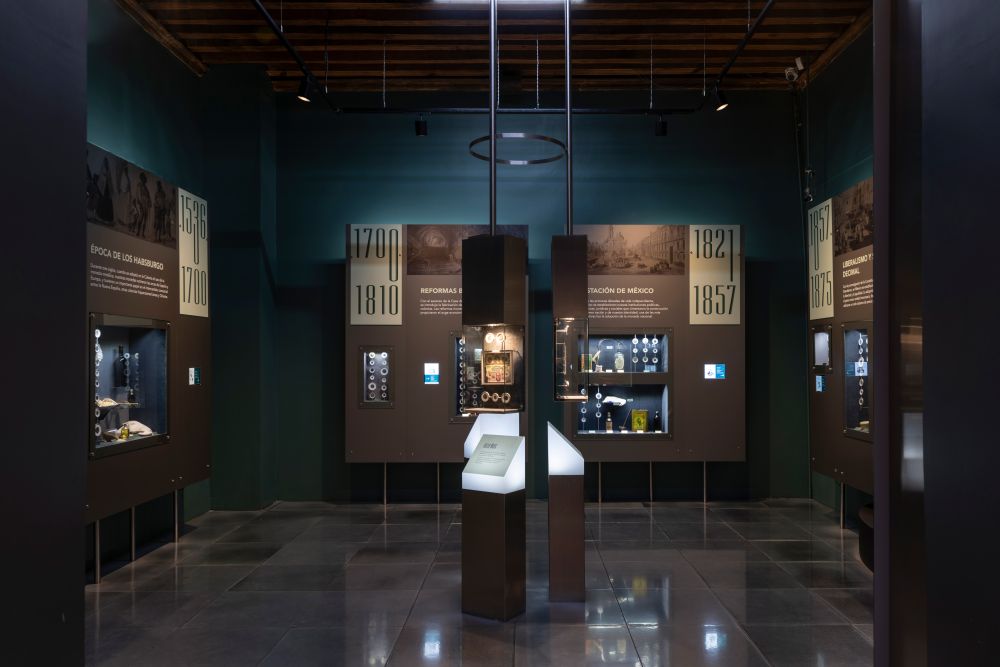
formalighting, in collaboration with Jorge Zinser of Zinser Studio SA, is delighted to announce the completion of the revived lighting design for the Interactive Museum of Economics (MIDE) – a pioneering cultural institution dedicated to making economic ideas and systems accessible through immersive, experiential museography.
Developed within an 18th century heritage building in the heart of Mexico City, the project demonstrates how light can become an active narrative tool when creative ideas and vision – rather than objects – are the primary exhibits.
Designing an interactive museum presents a distinct challenge; the focus is not on traditional artefacts, but on concepts, data and behaviours. At MIDE, the museographic approach prioritises the visitor’s experience before, during and after the visit, creating a journey that is engaging, intuitive and memorable. As such, the lighting strategy was conceived as a fundamental component of this experience, supporting the architectural language while reinforcing the museum’s educational mission.
For MIDE, lighting plays a central role in shaping atmosphere and legibility throughout the galleries, emphasising the building’s historic architecture, responding to its materiality and colour palette, and ensuring clear visibility of large-scale graphics and written content. Special attention was given to the lighting of artefacts and interactive elements that support the communication of ideas, allowing them to stand out without visual noise.
At the building’s entrance, key architectural features were carefully accentuated to enhance their presence in the urban context, inviting passers-by to discover both the restored historic structure and the contemporary museum within. Passing through to the main staircase, two trompe-l’œil optical illusions evoke a sensory experience of the bygone courtyard – providing visitors full conceptualisation of the historic environment they are walking through.
For the interior galleries, detailed lighting studies and simulations informed the precise positioning, aiming, beam angles and output of each luminaire. Particular care was taken to minimise glare and avoid unwanted reflections or interference with screens and interactive displays. Where required, light was seamlessly integrated into bespoke furniture in alignment with the museographic narrative. The resulting environment is warm and comfortable, with balanced illuminance levels that support exploration and understanding.
All luminaires are high-performance LED fixtures with excellent colour rendering, controlled via a wireless system that allows individual adjustment of each fitting. This flexibility enables different elements – graphics, images, texts and objects – to be subtly contrasted and emphasised as part of the storytelling.
Throughout the project, the constraints of a protected heritage building were fully respected. The intervention is entirely reversible, integrating contemporary engineering systems to the highest safety and quality standards while complying with all relevant regulations.
Michael Monsonego, CEO of formalighting, commented: “MIDE is a powerful example of how lighting can transcend illumination and become part of the museographic discourse. By carefully balancing technology, heritage and human experience, this project shows how light can help complex ideas feel accessible, engaging and inspiring. We were delighted to support Jorge in bringing the vision to life and ensuring visitors leave with lasting memories.”
Jorge Zinser, Principal Lighting Designer at Zinser Studio, added: “In a museum where ideas are the exhibits, light becomes a language. At MIDE, lighting was designed to guide, to clarify and to create atmosphere – supporting the visitor’s journey and reinforcing the way economic concepts are perceived and understood. formalighting’s advanced solutions and expertise in museum lighting enabled the final delivery to be as impactful as we had aimed.”
Together with the broader museographic design, the lighting project enables MIDE to achieve its objective; explaining how the economy works and how everyday decisions –from saving and consuming to recycling and entrepreneurship – can contribute to a fairer and more sustainable future for generations to come.
Project Credits:
Project – Museo Interactivo de Economia (MIDE)
Location – Mexico City, Mexico
Lighting Designer – Jorge Zinser
Additional Design – RIWA Arquitectura – MIDE (Museo Interactivo de Economía – Design Team)
Client – Fideicomiso del Espacio Cultural Betlemitas (FECEB-MIDE)
Photography – Jaime Navarro Estudio