
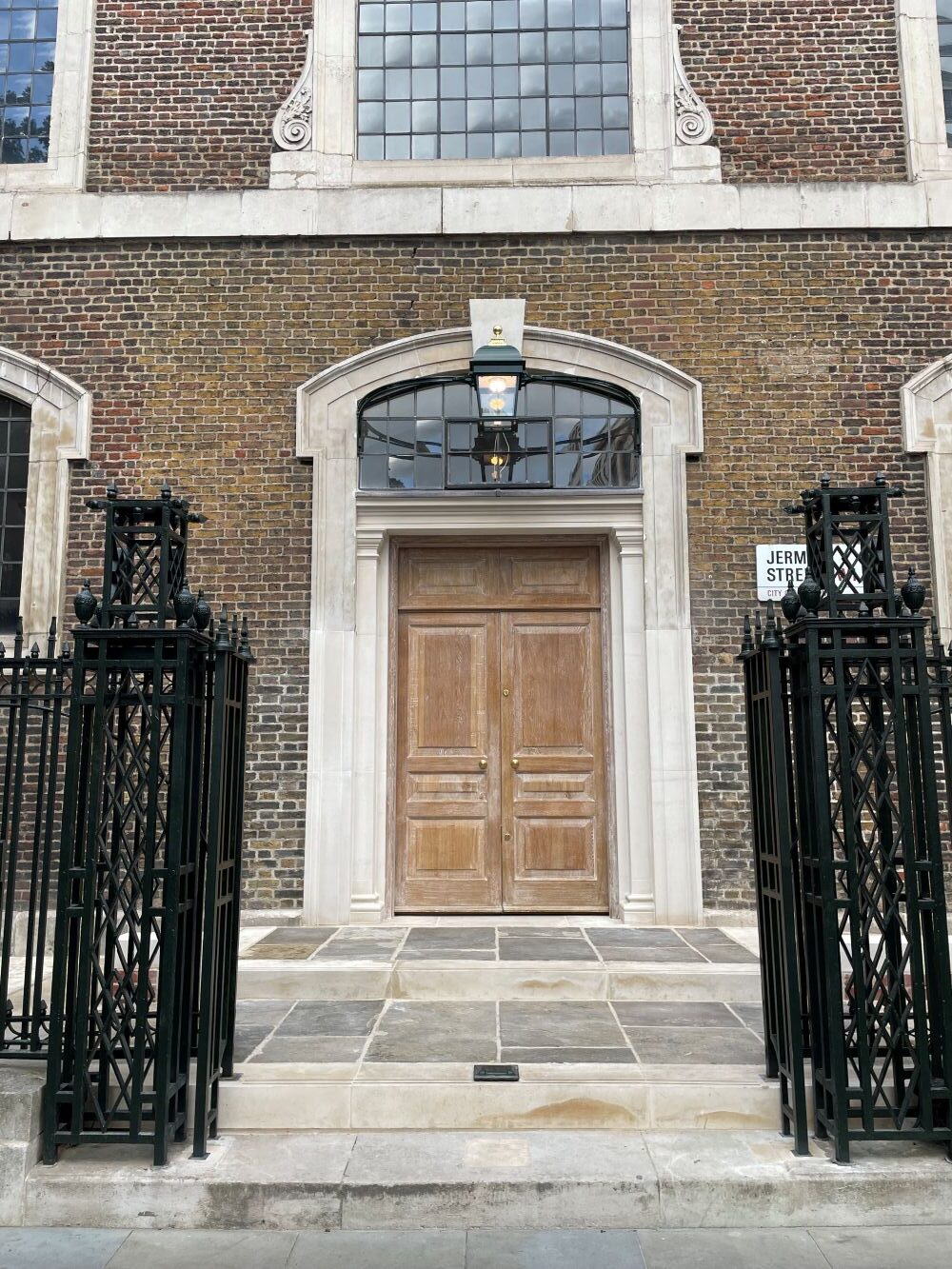
At the heart of Piccadilly stands the Grade I listed St James’s Church, Piccadilly, designed by Sir Christopher Wren in the aftermath of the Great Fire of London. Centuries later, The Wren Project is breathing new life into this historic site through a multi-million-pound restoration and rejuvenation programme. Phase one was completed earlier this year, focusing on four key areas, including the reinstatement of the South Door onto Jermyn Street, a vital architectural and symbolic element of Wren’s original design. The door had been walled up in the 1840s to accommodate a growing congregation, but as part of the renovation, the entrance has since been reopened, with a bespoke William Sugg & Co. replica lantern and replica bow bracket positioned above the new entrance. The existing lantern and bracket sited above the North entrance were used as the inspiration for the new doorway and they were also fully restored and converted LED Mock Mantles as part of the works.
The Wren Project
The comprehensive Wren Project restoration is taking place over multiple phases, transforming the site, sanctuary, courtyard, gardens and the Piccadilly building. The project will not only restore the historical site but also amplify the church’s efforts in environmental activity and social outreach with people experiencing homelessness, refugees, asylum-seekers and those persecuted because of their sexuality and identity. With 40,000 visitors each month, the historic site is a prominent fixture in the local area and will be open to even more of the community with these changes in place.
William Sugg & Co. had previously been approached regarding heritage lighting for the church, crafting a Grosvenor lantern for Robert Myers’ gold-medal-winning ‘St James’s Piccadilly: Imagine the World to be Different’ garden at the RHS Chelsea Flower show in 2024. Whilst there was no direct link between the show’s commission and the South Door project, both were part of The Wren Project, and the success and historical resonance of the lantern design at the show reinforced William Sugg & Co.’s suitability for the main church restoration. Echoing the ethos of St James’s Church, the garden symbolised hope, recovery and a call to revitalise urban green spaces with climate-resistant plants. Featured in the garden was an archway reminiscent of the gateways leading to the churchyard, from which hung a heritage lantern by William Sugg & Co. Commissioned by Stewart Landscape Construction, the Grosvenor lantern was chosen to reflect Piccadilly’s historical context and act as a guiding light into the garden. The plants have since been reestablished in St Pancras Euston Road church, St James’s partner church, and alongside the hard landscaping, the lantern will be restored to St James’s garden.
The Art and Engineering Behind the New Lantern
William Sugg & Co. was chosen to create an identical replica lantern and bracket for the South Door on St Jermyn Street, reproducing the distinctive bow bracket and lantern restored by the team adorning the North Door. Ptolemy Dean Architects, specialists in the conservation of historic buildings, utilised William Sugg & Co. to design and manufacture the lantern, alongside experts in masonry and carpentry to construct the Portland stone doorway and English oak door. The lantern head was crafted from copper, skilfully formed onto a robust steel body to ensure durability. To maintain historical authenticity, the design incorporated mock mantles, providing the warm, inviting glow typical of traditional gas lanterns, whilst harnessing a state-of-the-art, energy-efficient LED source discretely housed within. Emergency lighting functionality was also incorporated.
To ensure visual harmony, individual components were custom-made to achieve the intricate lines and curves characteristic of the original’s ironmongery. During the restoration, tiny flecks of gold leaf were discovered on the original lantern’s cap and spike, prompting the team to gild the new lantern’s cap and spike, an elegant nod to the church’s decorative heritage. The green paint selected for the lantern was precisely matched to the railings, maintaining continuity within the wider site landscape.
The South Door was reintegrated following Sir Christopher Wren’s original designs, which visually drew residents to the door through its considered sightlines. Now with step-free access and a bespoke lantern lighting the way on a boldly realised bracket, the entrance welcomes everyone to the sanctuary.
The integration of the new lantern and bracket posed several technical challenges, particularly in ensuring a seamless fit to the newly constructed Portland stone doorway and English oak door. The design required zero tolerance in fixing it to the facade, as the bracket had to sit precisely within the new stone side faces without compromising the historical line of sight or the structural integrity of the entrance. The lantern housing was engineered for accessibility, allowing for straightforward maintenance and unobtrusive integration of emergency lighting functions, crucial for public safety, yet designed so that the red emergency light would not be visible, preserving the lantern’s period appearance.
Change for the Better
At the heart of the Wren Project is a commitment to inclusivity and community. The reinstated South Door, now featuring step-free access and illuminated by the bespoke lantern, symbolises the church’s desire to break down barriers and welcome all who pass through its doors. Enhanced lighting, improved entrances and intentionally designed seating have transformed the church and gardens into accessible spaces that embody the church’s ethos of belonging regardless of faith or background. The reopened entrance and revitalised public realm are set to increase engagement and participation in the church’s diverse social and cultural programmes.
Lighting has always played a significant role in ecclesiastical architecture, representing hope and guidance. The new lantern at St James’s Church revives a lost architectural feature and serves as a symbol of the church’s enduring mission to illuminate the path for all who seek solace, inspiration or community. The careful restoration and bespoke craftsmanship respect the church’s storied past, whilst embracing the evolving needs of a diverse and dynamic congregation.
Neil Stanton, Managing Director of William Sugg & Co., comments, “The restoration of St James’s Church, Piccadilly, demonstrates the importance of retaining skilled heritage crafts in modern construction. This project highlights how heritage restoration can be respectful of the past and responsive to current needs, with every decision guided by the need to preserve the appearance and functionality of the entrance and Christopher Wren’s original design. Our contribution to St James’s Church is grounded in skilled workmanship and a collaborative approach, ensuring the building continues to serve its congregation and visitors well into the future.”