
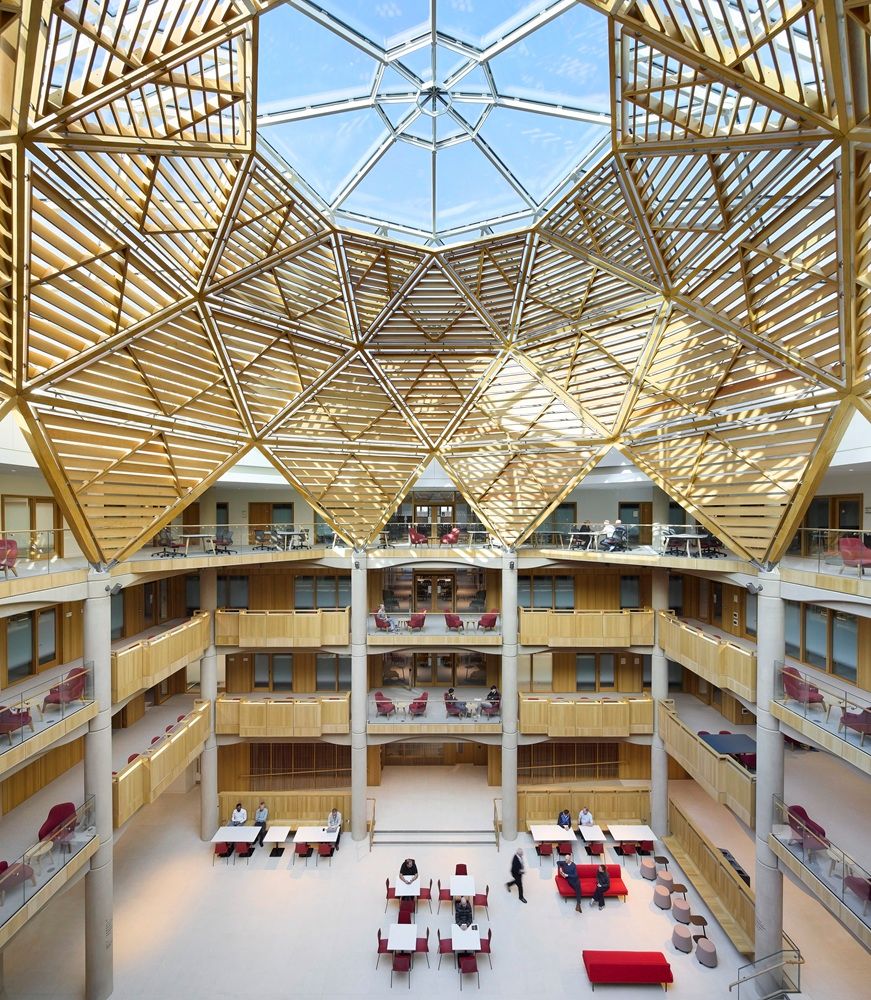
Delivering lighting across teaching, performance, library and
public spaces, TRILUX supplied 6,691 luminaires for the Stephen A. Schwarzman Centre for
the Humanities at the University of Oxford — one of the University’s most ambitious
building projects. The scheme combined bespoke product development with TRILUX’s
standard portfolio.
At the heart of Oxford’s Radcliffe Observatory Quarter, the Stephen A. Schwarzman Centre for the
Humanities brings teaching, research, performance and public engagement together within a
single cultural campus. Designed by Hopkins Architects with Max Fordham as M&E engineers and
lighting designers, and delivered by main contractor Laing O’Rourke, the project represents the
largest single building development ever undertaken by the University.

TRILUX played a central role in delivering the lighting for the Schwarzman Centre, supplying 6,691
luminaires across the building, including general, architectural and emergency lighting solutions.
The building combines academic facilities, performance venues, libraries and public spaces across
more than 25,000 square metres and has achieved Passivhaus certification.
A Lighting Strategy for Complex Spaces
The diversity of spaces within the Schwarzman Centre required a flexible lighting approach
capable of supporting both specialist performance environments and everyday academic use. Key
architectural areas such as the main entrance, Great Hall and concert venue required carefully
integrated lighting solutions, while teaching spaces, circulation areas and study environments
demanded efficient, reliable illumination.
Lighting across the site uses wireless lighting control. TRILUX supplied wireless luminaires with
Bluetooth connectivity throughout the building, supporting flexible scene setting, zoning and real-
time lighting adjustment across the campus.
Bespoke Meets Standard
A key element of TRILUX’s contribution to the project was the development of a bespoke luminaire
for the library spaces. The solution was designed to deliver uniform vertical illumination across
library shelving, ensuring consistent light levels from top to bottom while maintaining visual comfort
for users.
Achieving this level of performance from a compact luminaire profile required careful optical
design, allowing the fitting to deliver multiple light angles from a single channel. The bespoke
solution formed part of the proposal that helped secure the project.
Alongside this bespoke development, TRILUX supplied luminaires from its standard portfolio
across the wider building, ensuring consistency of lighting quality while supporting efficient
installation and maintenance.
Amongst others, Finea linear luminaires were installed extensively across teaching spaces, offices,
and circulation areas, while Sonnos downlights were widely used throughout social and shared
environments. In performance and service areas, Oleveon and Aragon luminaires provided robust,
reliable illumination. Office environments were supported by Siella G5 suspended luminaires, with
Onplana downlights used across a range of working spaces.
Together, these solutions formed a coordinated lighting approach across the diverse environments
within the building.
Supporting Passivhaus Performance
Sustainability was a core principle of the Schwarzman Centre design. As a Passivhaus-certified
building, the project required highly efficient building systems and careful coordination across
disciplines.
TRILUX’s lighting solutions support these ambitions through high-efficiency luminaires and
intelligent control, helping to minimise energy consumption while maintaining appropriate lighting
quality across academic, cultural and public spaces.
Collaboration on a Complex Project
Collaboration across the project team played a key role in delivering the lighting strategy. TRILUX
worked closely with Max Fordham, Laing O’Rourke and other partners to ensure the lighting
solutions aligned with architectural intent, construction methodology and long-term operational
requirements.
The project demonstrates TRILUX’s ability to support complex, large-scale developments through
a combination of bespoke design capability, reliable product solutions and flexible lighting control.
A Future-Ready Cultural and Academic Space
The completed Schwarzman Centre provides a flexible environment that supports teaching,
research, performance and public engagement. The lighting strategy plays an important role in
shaping these spaces, creating environments that are comfortable, adaptable and efficient.
As one of the University of Oxford’s most significant building projects, the Schwarzman Centre
highlights how lighting design, product innovation and collaboration can support world-class
academic and cultural environments.