Categories
Uncategorised

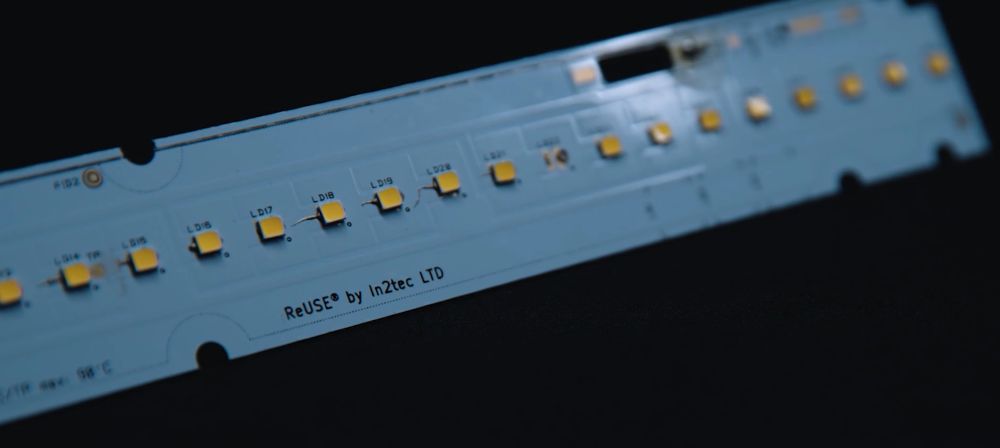
Lighting the Way to Circularity: How ReUSE® Technology Is Transforming Industrial Lightbars

In2tec, a pioneer in sustainable electronics, is redefining how industrial lighting contributes to a
circular economy — with a breakthrough approach that dramatically reduces carbon emissions and
electronic waste.

As energy costs surge and environmental regulations tighten, industries are increasingly turning to
LED lightbars for their efficiency in industrial and commercial applications. In2tec’s ReUSE® and
ReCYCLE™ technologies take sustainability far beyond energy savings — enabling lightbars to be
fully disassembled, repaired, and reused, unlocking a new era of low-impact lighting.
“We’re seeing a 62.5% reduction in CO₂ emissions during manufacture compared to conventional
PCBAs,” says Emma Armstrong, Sustainable Electronics Ambassador at In2tec. “And with over 20 million lightbars sold annually, that translates to nearly 3.9 million kilograms of CO₂ saved — everyyear.

Designed for Disassembly, Built for Reuse

At the heart of this innovation is ReUSE®, a suite of materials and design techniques that allow
printed circuit boards to be unzipped at end-of-life — separating and recovering components
without damage. Paired with ReCYCLE™, a low-energy recovery process, manufacturers can reclaim
valuable substrates and components for second-life applications.

This is a game-changer for industrial lighting, where long-life components are often discarded
prematurely due to traditional rigid assembly methods like solder. With ReUSE®, components retain
their integrity, enabling in-life repair, reuse, and resource conservation — all with minimal
investment from OEMs.

Lighting That Works for the Planet

Lighting systems are a major contributor to global energy use and ewaste. According to the UN, 61.3
million metric tonnes of ewaste were generated in 2023 alone. In2tec’s technology directly
addresses this crisis by embedding sustainability at the heart of the design phase, ensuring that
every lightbar is part of a truly circular model.
“We’re not just reducing emissions — we’re changing how electronics are made and unmade,”
Armstrong adds. “This is about designing lighting systems that work for the planet, not just the
bottom line.”

Seamless Integration for Industrial Applications

ReUSE® is compatible with traditional and alternative substrates, including FR4, PET and Aluminium,
making it ideal for integration into existing industrial lighting systems. It delivers bond strengths
near equivalent to solder at significantly lower manufacturing temperatures, significantly reducing
energy consumption during both manufacture and end-of-life processing.
For manufacturers, this means:
 Lower production emissions
 Lower energy consumption in manufacture
 Enhanced repairability
 Valuable material recovery through electronics circularity
 Compliance with WEEE and sustainability mandates

In2tec brings over 25 years of expertise in flexible electronics and sustainable innovation. With
ReUSE® and ReCYCLE™, the company is lighting the path toward a low-carbon, circular future — one
lightbar at a time.

Discover more about In2tec’s technology at https://in2tec.com/reuse

Categories
industry updates Uncategorised

Ansell Lighting Enhances Bollards Offer With Avio and Tauro

Ansell Lighting has unveiled two versatile new additions to its bollards range, Avio and
Tauro, delivering unrivalled versatility, performance and ease of installation.
Suitable for multiple outdoor settings ranging from commercial, healthcare, education and
hospitality, to retail ancillary, Avio and Tauro are the ideal choice for installations such as
large car parks, high-level feature perimeter lighting, emergency lighting and parks.
Both the 930mm x 170mm Avio and slightly taller Tauro (1040mm x 170mm), offer
interchangeable heads with a half-shield lens option to provide single direction output. A
precision engineered lensed optic ensures exceptional light distribution and performance,
delivering maximum efficiency and a guarantee of visual comfort endorsed with Dark Sky
approval.

Minimal effort installation and maintenance is a key factor in the design of Avio and Tauro,
which come complete with AFIX IP connector and optional root mounting kit and head
shields accessory.
The integrated CCT and wattage switches are housed within the removable head of the
bollards for easy access, ensuring fast and efficient installation and ongoing maintenance.
Adler rotational legends, which remove the need to stock multiple legends, are another
bonus.

Avio and Tauro are robust die-cast aluminium bollards with a textured graphite finish, with
IP66 and IK08 ratings and a L80, 77,000 hour lifespan attesting to their durability and
meriting a five-year warranty.
Available in black and silver/grey, they are OCTO compatible, CCT selectable between
3000K and 4000K and power selectable, offering a choice of four outputs in one luminaire.
Additionally, they deliver a highly efficient light source of up to 120lm/W.
Mark Abbott, Managing Director at Ansell Lighting, said: “With Avio and Tauro we have
created the complete package – versatile, installer-aware and providing the ultimate in
reliability while meeting illumination requirements and visual comfort needs within outdoor
environments.”

Categories
industry updates Uncategorised

New WEEE Regulations published today

New regulations that will require online marketplaces to finance recycling of electrical waste were
published today. The new waste electrical and electronic equipment (WEEE) regulations laid before
parliament close a crucial loophole that has allowed non-compliant product to be sold via online
marketplaces.

Commenting on the news, Recolight CEO Nigel Harvey said “For over a decade, online marketplaces have facilitated the sale of WEEE non-compliant products on an industrial scale. The consequences have been very damaging for legitimate UK businesses. The sellers of non-compliant products have gained an unfair advantage because they do not pay their share of recycling costs. But to add insult to injury, that has in turn meant that WEEE costs to compliant businesses have been higher than needed.”

The new regulations mean that online marketplaces must report all household electricals within the
scope of the existing WEEE regulations from non-UK suppliers. As a consequence, online
marketplaces will incur some additional WEEE costs in 2026, with full costs being allocated from
2027.

The lighting industry has been particularly impacted by the scale of freeriding on online marketplaces.
A survey by the UK WEEE Scheme Forum showed that 76% of LED lamps offered for sale on a major
marketplace were not registered for WEEE.

Nigel Harvey added “This is a great day for many companies in the UK lighting industry. At last, the
end is in sight for this unfair competition. Recolight has pushed long and hard for this change, on
behalf of our 220 members.”
“The mechanism that the government has chosen to implement the change is particularly efficient:
rather than requiring many tens of thousands of non-UK companies to register for WEEE, they have instead placed that obligation on the small number of online marketplaces. That makes enforcement
by the UK environment agencies much more straightforward.”

Categories
industry updates Uncategorised

Emergency Lighting: A Key Priority Amid Building Remediation

Mackwell – David Lang-Smith, Sales & Marketing Director UK & Europe | Emergency Lighting Experts

Recent developments to the Building Safety Act 2022, alongside the introduction of the Leasehold and Freehold Reform Act 2024, have outlined significant changes to the UK’s approach to building safety and accountability. These changes have introduced a more stringent framework for ensuring that buildings, particularly those deemed high-risk, undergo appropriate and often overlooked due to funding, remediation. The introduction of remediation orders and a sharper focus on interim fire safety measures ensures that residents are protected while longer-term works are undertaken.

This renewed scrutiny is driving a wave of remediation activity across the country, particularly in residential blocks with already identified safety deficiencies. Since terrible tragedies such as the Grenfell Tower fire, attention has been placed on cladding and structural issues, alongside fire safety measures, such as emergency lighting. In the event of a fire or power outage, emergency lighting plays a primary role in supporting both evacuation and emergency response.

The updated legislation makes it clear that building owners and accountable persons must take full responsibility for the safety systems in place. For contractors, consultants and facilities managers, this presents a growing opportunity to bring existing systems up to standard and deliver new solutions that align with the legal and safety requirements.

The changes in legislation now place clear legal duties on the ‘responsible person’(often building owners or managing agents) to identify, fund, and carry out necessary remedial work to address risks to life in buildings. Specifically, the Building Safety Act introduced Remediation Orders and Remediation Contribution Orders, giving the Building Safety Regulator and the First-tier Tribunal (FTT) the power to enforce remediation of fire safety defects, including inadequate emergency lighting, faulty alarm systems, and other critical safety failings.

The Leasehold and Freehold Reform Act 2024 further supports leaseholders by limiting the financial burden on residents, placing the onus directly on the responsible persons. Failure to follow these legislations can now result in legal penalties, and in extreme cases, criminal liability.

For buildings relying on interim measures such as waking watches, responsible persons can no longer delay action. Waking watches were introduced as a temporary fire safety measure in high-risk buildings, particularly those identified with cladding or fire compartmentation issues. Their incredibly costly but essential role provides on-site fire wardens who monitor the building around the clock and raise the alarm in the event of a fire. While intended as an interim solution, waking watches have faced significant scrutiny due to their astronomical ongoing costs and the inconsistency in effectiveness. As a result, regulatory focus has shifted toward replacing waking watches with more reliable, long-term safety solutions, such as the installation of compliant fire detection and emergency lighting systems.

Regulators are increasingly insisting that interim solutions be replaced with permanent, compliant safety systems. This shift shows that inactivity is no longer tolerated, and proactive, accountable remediation is now legally imperative.

At Mackwell, we know that emergency lighting is the foundation of an effective fire safety strategy. Our systems are designed to perform when it matters most, and with increasing focus on digital monitoring and data-led maintenance, we’re helping clients stay ahead of compliance. Our Automatic Test System (ATS), N-Light, helps clients stay ahead of compliance requirements. It can be easily integrated into existing buildings using our wireless technology, and with our cloud-based platform, users can remotely monitor one or multiple buildings. At Mackwell, we remain committed to delivering the technical support, guidance and high-performance solutions that building safety demands.

Emergency lighting is not a background detail – it’s a life-saving measure. As more buildings come under remediation scrutiny, now is the time to reassess, upgrade and invest in emergency systems that meet today’s expectations and tomorrow’s standards.

Categories
Uncategorised

Timage Advert Home Page