Categories
industry updates

All Roads Lead to Tridonic’s Centre of Competency in Spennymoor as they Welcome Elias Kernbichler, Global Product Manager Emergency Lighting

As Tridonic UK continues to set the standard and trailblaze in innovative solutions, they are delighted to welcome Elias Kernbichler, Global Product Manager Emergency Lighting, on a 6-month secondment to strengthen and enhance customer experience.

In this role, Elias will focus on aligning market and customer demand with the continuous development of Tridonic’s Emergency Lighting portfolio.

Working directly with the UK market to gain deeper insights, he will be forging stronger links between industry needs and expectations, that will channel into Tridonic’s operations and R&D teams – ensuring that Tridonic solutions are future proofed across the UK and greater business regions.

His experience and product expertise, spanning over fifteen years, will support improved collaboration across departments – ultimately contributing to more forward-thinking products, and effective delivery of customer-focused solutions specific to the UK market.

Commenting on the assignment, Elias said: “This is a valuable opportunity to build greater Emergency Lighting solutions, and stronger cross-functional relationships to improve alignment between our central and regional R&D and operations teams. By working closely with my colleagues in the UK, we can further enhance services – ensuring we continue to deliver high-quality solutions for our customers.”

Beyond his professional role, Elias is looking forward to experiencing the cultural and historical heritage of the UK. He has expressed particular interest in exploring historic sites and enjoying the British countryside, noting with humour his anticipation of the “sunny” winter season.

Tridonic UK Managing Director, Richard Strode, commented: “We are delighted to welcome Elias to the UK team for this assignment. His knowledge, insights, and holistic company perspective will be invaluable as we continue to push forward greater innovation of our Emergency Lighting portfolio and collaboration across departments to deliver innovative solutions for our customers. His secondment demonstrates our commitment to advancing Emergency Lighting innovation and delivering practical, high-quality solutions that meet evolving customer needs. We look forward to the positive impact Elias will make during his time in the UK.”

Categories
industry updates

Swivelpole™ Launches in Europe with Retrofit Solutions

Global safety innovator Swivelpole™ has officially launched its European operations, bringing over 25 years of lowering pole technology. With a new office and warehouse in Rotterdam, the company is primed to support commercial and industrial industries across Europe and the UK with safer, smarter, and more cost-effective retrofit solutions.

Swivelpole™ is the trusted choice of leading companies in the world’s toughest environments – now accessible locally for European projects.

Swivelpole’s retrofit offering makes access easy, by offering existing handrail mounted poles to be converted to lowering poles by installing a Maxis™ joint using the pole conversion tool kit. With the ability to safely lower pole mounted equipment to walkway level, the system eliminates the need for ladders, scaffolding, or aerial work platforms. The result is faster, safer and more affordable upgrades, maintenance and inspection without disrupting operations.

“Installing a Swivelpole™ costs less than building scaffolding,” said Amy Olsen, Group General Manager at Swivelpole™. “We’re thrilled to bring our proven retrofit solutions to Europe and the UK, helping companies upgrade infrastructure, switch to LED lighting, improve maintenance access and boost safety with minimal investment.”

With industrial sectors across Europe and the UK racing to modernise ageing infrastructure, improve workplace safety, and meet environmental targets, Swivelpole™ offers a cost effective and safe solution. The technology is ideal for retrofitting legacy sites and brownfield projects, providing a compliant, engineered solution for safe access to lights and pole-mounted equipment.

Swivelpole™ transforms existing poles into safer, more efficient lowering poles using the globally patented Maxis™ joint, allowing equipment to be lowered to walkway level for maintenance. This innovation eliminates the need to work at heights, significantly reducing safety risks while enabling faster LED upgrades and routine servicing. By streamlining access, it reduces operational costs and downtime, while its engineering and certification to European safety standards ensures compliance across industries. Backed by a 10-year warranty, Swivelpole™ delivers long-term confidence and performance in even the most demanding environments.

The official European launch has now opened up new markets, providing global expertise with locally available stock.

Swivelpole™ now stocks all standard products at its Rotterdam Distribution Centre, ensuring fast shipping across Europe and the UK. The company’s products are manufactured to IEC standards and carry both CE and UKCA markings for compliance in the EU and UK. Backed by decades of global experience, the team offers guidance and is available to discuss specific projects and requirements upon request. Technical drawings and related documentation are available on the website.

With over 500,000 installations worldwide, Swivelpole™ continues to lead the way in safety, performance, and reliability across Oil & Gas, Mining, Industrial, Infrastructure, and Commercial sectors.

Find Out More – To discover how Swivelpole™ can transform your infrastructure, visit www.swivelpole.com or contact the European team at sales.eu@swivelpole.eu.

Categories
industry updates

CU Phosco Becomes Sustaining Member of DarkSky UK to Champion Better Night-Time Lighting

CU Phosco, the UK’s longest-established and leading exterior lighting manufacturer,
is proud to announce that it has joined DarkSky UK as a Sustaining Member,
strengthening its commitment to responsible, low-impact lighting and the protection
of the night sky.

As part of the partnership, CU Phosco will support DarkSky UK’s work throughout
the year and will take part in the DarkSky UK Conference 2025: “Good Lighting:
From Pollution to Solution”, held at Newcastle University on 9 September 2025. CU
Phosco will be exhibiting on the day and engaging with lighting professionals,
designers, research organisations and policy makers to share best practice and
encourage the adoption of dark sky-compliant solutions across the industry. On
display will be the International DarkSky-approved P862, P863, and E950 as well as
the HEPER Lighting DRAGO and DOGO.

The conference, supported by organisations including the ILP, IALD, LIA, SLL, ECA
and Dark Sky Discovery, aims to strengthen links between research, policy and
practice, and help move compliant lighting “from niche to mainstream”.
Matt Murray, Sales Director at CU Phosco, commented:
“We’re very pleased to be supporting DarkSky UK and the important work they do to
promote responsible, evidence-based lighting. As a UK manufacturer with several
dark sky accredited products in our range, we’re committed to reducing light pollution
and working collaboratively to improve the night-time environment.

Supporting this initiative is a natural step for us and we look forward to sharing
knowledge and engaging with partners across industry, design and conservation at
the 2025 conference.”

From street lighting to high-mast and architectural solutions, CU Phosco continues to
develop luminaires that combine optical precision with minimal upward light output,
many of which are already certified under the DarkSky Approved scheme.

More information on CU Phosco’s dark sky lighting ranges is available here:
https://www.cuphosco.com/articles/lighting-for-darkskies

Categories
industry updates

White Light Powers Jesus Christ Superstar at the Watermill Theatre

White Light (WL) is proud to have supported the Watermill Theatre’s bold and atmospheric production of Jesus Christ Superstar, with lighting design by Rory Beaton. This reimagining of the iconic rock opera transformed the intimate Berkshire venue into a space of epic scale and spiritual resonance, thanks in no small part to a lighting design that was both technically ambitious and emotionally precise.

From the outset, Beaton’s vision was clear: to turn the Watermill into a derelict, sacred space—part concert hall, part gothic chapel—where a group of storytellers could gather, instruments in hand, to share a timeless tale. “We wanted the space to feel like it carried architectural weight,” he explains. “To be able to flip between a raw, church-like intimacy and a full-blown concert aesthetic.”

With limited physical space and minimal scenic elements, lighting became the primary storytelling tool. Beaton’s design used light to shift scale, sculpt mood, and guide the audience through the emotional arc of the show. “You can’t fly in massive set pieces at the Watermill,” he says. “So lighting had to do the heavy lifting; shaping the room, igniting the atmosphere, and telling the story.”

To achieve this, Beaton relied on a carefully curated rig that balanced power with subtlety. At its heart were 42 Martin Mac Ones which are compact, quiet, and impressively versatile. “They’re the perfect unit for a space this size,” he notes. “They take up almost no space or power, and they pack an immense punch.”

The rig also included Ayrton Diablo-S profiles, Martin Mac Auras, and a range of LED fixtures, all chosen for their ability to deliver visually rich, almost biblical imagery one moment, and high-energy concert looks the next. Hidden troughs of GLP Xbars and LED tape added depth and texture, while 88 hand-crafted DMX candles brought a human, tactile warmth to the stage.
WL’s long-term hire partnership with the Watermill was instrumental in realising this vision. “It would have been impossible to produce this show with this aesthetic without supplementing the existing stock,” Beaton says. “I’m so grateful to Adam, Stuart, and the entire WL team for helping us find the right kit, on budget and on time.”

The production also pushed the venue’s technical infrastructure to its limits. “We ran out of parameters on the desk,” Beaton laughs. “But WL stepped in to upgrade the system and make it all possible.”

WL’s Business Development Manager Stuart Porter comments: “At WL, we believe in creative partnership and technical excellence. This production exemplifies both. It’s a testament to what can be achieved when designers, technicians, and suppliers work together to tell powerful stories sustainably, and collaboratively.”

As Beaton reflects: “This show is a herculean effort from everyone involved. I wouldn’t have been able to do half of what I did without the brilliant team of freelancers, Watermill staff, and the unwavering support of White Light.”

LX Team Credits:
Rory Beaton – Lighting Designer
Nicola Crawford – Assistant Lighting Designer
Luca Panetta – Lighting Programmer
Ryan Tate – Production Electrician
Richard Lodge – DSM

Thom Townsend, Ruth Corris, Alex Hammond, Nick Flintoff, Lawrence Doyle and Neil Starke at the Watermill.

Categories
industry updates

International Software Firm, Munich

Light Forms was specified by architects Kinzo to deliver all the lighting solutions for the new Munich office of an international software firm, with a brief that demanded innovation, individuality, and technical finesse.

Guided by Kinzo’s vision of a workspace that feels both personalised and distinctly Munich, Light Forms ensured lighting became more than a functional layer – it was designed as a core architectural element and a driver of atmosphere across the office’s 5,500 sqm.

Light Forms solutions combined statement pieces with highly functional systems. The Serpentine system and MoonBands introduced a contemporary signature, while custom Lightplane 2.5 fixtures provided clear, functional illumination along high-traffic circulation routes. For focused and comfortable task lighting, Light Forms integrated Nova Medium downlights across workstations and meeting rooms.

In the central social zones, a striking visual focal point was created with MoonRings, complemented by a bespoke ceiling rose – fabricated to a unique UK specification. Conceived as both a technical and a sculptural centrepiece, it symbolises the fusion of engineering precision and artistic expression.

From this centrepiece, ELOA Glass Pendants in both Hebe and Haumea versions were suspended, adding warmth and a touch of elegance that set the tone for the wider space. Each lighting decision was carefully coordinated with Kinzo to balance performance with ambience – ensuring the office’s users enjoy a workplace that inspires comfort, collaboration, and identity, all with a modern finish.

Reflecting on the result, Laura from Kinzo said: “Light Forms’ technical expertise elevated our concept in every space. Their bespoke solutions, especially the custom ceiling rose and feature lighting brought our ideas to light and made the office truly distinctive.”

The Munich office demonstrates what’s possible when architectural vision and lighting design work hand in hand. By uniting technical precision with creative expression, Light Forms helped shape an environment that is both functional and inspiring. In this project, lighting doesn’t just illuminate; it defines character, enhances wellbeing, and expresses the company’s identity in every detail.

Project credits:

Client: International Software company
Interior Architects: Kinzo
Photography: © Sorin Morar | Kinzo

Categories
industry updates

COLLABORATING TO DELIVER A BESPOKE CEILING LIGHTING

Material Source Studio, Manchester

Material Source Studio (MSS) in Manchester serves as a hub of innovation and inspiration for design professionals. Featuring installations from over 50 leading brands, the space offers a dynamic mix of product showcases, seminars, workshops, CPDs, and networking opportunities. The studio is purposefully designed to foster creativity while offering a comfortable, collaborative environment for designers and architects.

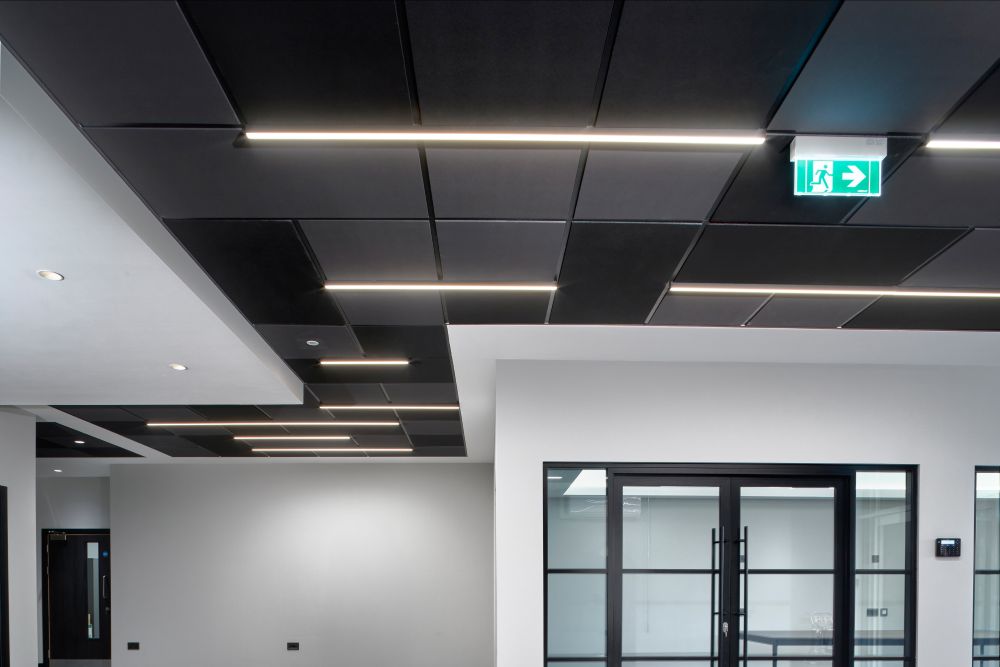
When Material Source Studio sought to enhance its meeting room with a bespoke ceiling lighting solution that would push the boundaries of design, Light Forms, in collaboration with MSS partner, Zentia, stepped in to deliver a tailored solution.

The solution needed to complement the Studio’s soft furnishings while maintaining a cohesive visual identity. It also had to incorporate integrated lighting with acoustic performance, ensuring practical benefits such as a comfortable, functional atmosphere for co-working and networking.

Zentia proposed and delivered a bespoke solution featuring the DecoFrame Kit Classic Canopy, Gridline, and triangle tiles in a mixture of white and grey. Zentia’s Solutions Design Manager, Nick Harper, created the design alongside providing the expertise and partnership working that Zentia is known for.

Light Forms developed Trifecta, a slimline ceiling light to fit seamlessly with the Zentia’s design. Available in a variety of colour temperatures and CRI options (80 and 90), the fixture comes with a choice of either a homogeneous opal diffuser or a low-glare micro-prismatic diffuser- ideal for a wide range of spaces. Its full-coverage, LED backlit design ensures even illumination across the surface, delivering a clean and striking ceiling lighting solution.

John Spicer, Head of New Product Development at Zentia was happy with the result, he comments: “We’ve been encouraged by the positive feedback on how straightforward the installation process is, which led us to officially launch this as a product. To support architects and designers, we’ve developed a set of standardised Revit models, available to download from NBS Source, BIMobject, and our own website, making specification as seamless as possible. For bespoke designs, our in-house team is on hand to help turn your vision into reality.”

Paul Shoosmith, Director at Lighting Forms added: “It has been a pleasure to collaborate with fellow MSS partner Zentia on this bespoke solution, which we believe will be appreciated by designers across the Manchester region and beyond. We’re thrilled to introduce Trifecta to our collection as a standout lighting solution for diverse ceiling applications.”

Completed in July 2025, the final installation is a visually impactful, acoustically sound ceiling lighting solution – perfectly suited for presentations, board meetings, and creative collaborations at the Studio, a true flagship for design innovation.

Categories
industry updates

LUMY Awards Set to Spotlight Lighting’s Most Innovative Products

The LUMY Awards, a newly launched program dedicated to honoring the most innovative and exceptional lighting and controls products, is set to raise the bar for recognition in the global lighting industry.

The LUMYs will spotlight excellence across six categories — Indoor Luminaires, Outdoor Luminaires, Lighting Controls, Stocked Goods, Lamps, and Components — providing manufacturers with a highly credible platform for recognition and industry-wide visibility. A panel of six respected industry experts will evaluate entries based on rigorous criteria, ensuring that the program sets a true benchmark for quality and innovation.

“The LUMY Awards are about celebrating real innovation and quality in lighting,” said Al Uszynski, creator of the LUMY Awards. “This program brings a level of rigor and integrity that the industry can trust — a benchmark designed to reflect what true excellence looks like.”

The awards program will roll out over the coming months:

September – October: Entry period open. Weekly announcements unveiling members of the distinguished judging panel
October 25: Entry period closes
November: Four finalists per category announced. Public voting opens, counting as the seventh judge and representing one-seventh (14%) of the total score.
December: Category winners unveiled, with each product celebrated as a LUMY Awards winner

The LUMY Awards aim to deliver more than just recognition. Winners will gain significant exposure across the lighting industry’s design, distribution, and manufacturing sectors, reinforcing their position as leaders in lighting innovation.

Entries are open to manufacturers worldwide, reflecting the global nature of the lighting industry.

For entry guidelines, deadlines, and judging criteria, visit www.LUMYawards.com and be part of setting a new benchmark in lighting innovation.

Categories
industry updates

K-LITE Illuminates Nyati Enthral, Landmark Commercial Development

In early 2025, K-LITE completed an external lighting installation at Nyati Enthral, in East Pune’s largest mixed-use commercial tower developed by the renowned Nyati Group. With over two decades leading the way within real estate, the Nyati Group has shaped the city’s skyline across residential, commercial, hospitality, and healthcare sectors.

Strategically located with accessible connections to premium residential areas Kharadi, Wadgaon Sheri, Keshav Nagar, Mundhwa, and luxury hotels, and transport links to Pune Airport and major highways, Nyati Enthral redefines workplace environments with state-of-the-art offices designed for a balanced, modern lifestyle.

The project’s design brief called for an external commercial pathways solution that would ensure safety, comfort, and aesthetic cohesion across the development.

Appointed lighting designers, Semblance Design Studio, recommended K-LITE and its products based on their proven track record and expertise in delivering innovative, reliable, and visually striking outdoor lighting solutions. Following a successful mock-up and approval, the installation was delivered smoothly and completed in the spring of 2025.

Working closely with both the client, Nyati Group, and Semblance Design Studio, K-LITE supplied its 45W Salvia luminaires mounted on 3-metre circular poles, offering optimal light levels for pathways. Whilst the pure polyester powder coated finish complemented the contemporary architectural character of the commercial tower.

The result is a perfectly illuminated external space that enhances safety and accessibility while reflecting the sophistication of the development.

The Nyati Enthral installation is an example of K-LITE’s commitment to creating sustainable, functional, and design-driven solutions for India’s most forward-thinking architectural projects.

Project Credits
Lighting Designer: Semblance Design Studio, Pune
Client: Nyati Group

Products
45W Salvia with 3m circular pole

Categories
industry updates

The Case for Custom LED Optics in Product Design

It’s fair to say the LED lighting industry is now a mature and highly commoditised space. The supply chains for core LED lighting components – from the LEDs themselves to control electronics and secondary optics – are well-established. With so many vendors offering off-the-shelf solutions, it’s tempting to think that most LED products can be built from catalogue parts alone. And in many cases, that’s absolutely true. Here David Scott-Maxwell, Director at Forge Europa, shares key insights and considerations.

The Limits of Standard Secondary Optics

But what if you’re trying to do something different? Maybe you’re looking to add tangible value and stand out in a saturated market, or perhaps you’re developing a novel LED application in a specialist sector that doesn’t fit neatly into the “general lighting” box. In situations like these, customisation becomes essential – and some of the most powerful differentiation can be found in custom LED optics.

Why optics? Because standard secondary optics are, by necessity, designed to serve a broad range of use cases. That means compromises – on beam shape, efficiency, form factor, or integration. But here’s the good news: custom LED optic design is not only possible, it’s very often quicker, easier and more cost-effective than most expect. That said, one golden rule applies – never design optics in isolation.

To fully unlock the benefits of optical customisation, the optics must be treated as a fundamental part of the entire LED product design. Only by designing LED optics in tandem with the light source, thermal management, control gear, mechanics, and aesthetic considerations can you realise true optimisation.

Very few organisations have both the technical scope and the practical experience to do this well – Forge is proud to be one of them.

Let’s Define Our Terms: What is an LED?

But before we get into the “how,” let’s go back to basics: What exactly do we mean by LED optics? What role do they play in an LED system? And why are they so essential?

First, let’s define the term ‘LED’. We’re talking here about the bare electronic component – the Light Emitting Diode – which, when powered via control electronics, emits light. Commercially available since the 1960s, today’s LEDs come in a vast array of shapes, sizes, power levels, and colours.

But one key characteristic of LEDs has changed little since the 1960s – the light they produce is still of limited use on its own. Most LED light emission is unfocussed, which means it needs help to become usable in real-world applications. In technical terms, modern LEDs typically emit light from a flat surface, and their intensity varies according to the cosine of the viewing angle. This isn’t new – the cosine emission pattern, known as ‘Lambertian’, is named after Johann Lambert, who published a foundational book on light measurement – Photometria – way back in 1760.

Primary Optics vs Secondary Optics

While some LEDs incorporate built-in lenses – so-called ‘primary optics’ – these typically only focus the LED light emission modestly and don’t produce light that is particularly useful in real-world applications. To address this, it’s common to use separate optical systems positioned in front of the LED to collect, shape, and direct the light. These are known as ‘secondary optics’.

Such LED secondary optics can take many forms – lenses, reflectors, fibres, light guides, diffractors, prisms – and often combinations of these working together.

And while there are plenty of high-quality off-the-shelf LED secondary optics available, they all share the same limitation – they’re constrained in one way or another. That might be in terms of beam shaping, physical dimensions, optical efficiency, or even cost. Customisation, then, offers a clear path to overcoming these limitations and unlocking unique value in your LED-based product.

Cost Assumptions – And the Reality at Forge

But what about cost? There’s a common perception that custom optical components are prohibitively expensive – that the design time, tooling costs and minimum order quantities make them unviable unless you’re producing at huge scale.

While that may have been true in the past, it’s certainly not the case at Forge. With over 30 years of experience, advanced design tools, and flexible manufacturing, we can put some bold and very achievable numbers on the table.

Custom LED secondary optics are typically designed within a few weeks to a few months. The ODM design cost? Zero – we don’t charge for design (subject to the usual Ts & Cs, of course). Tooling costs are usually in the low thousands, and low-volume manufacturing runs – starting in the hundreds of units – are entirely possible.

The old saying goes “Good, Quick, Cheap – pick any two”. In most industries that holds true. But when it comes to custom LED optics, we’re confident we can challenge that rule.

How to Approach LED Optic Design

But how do you design LED secondary optics? Where do you start? Well, as mentioned above, the first and most important rule is this – don’t start with the optic. It’s essential to approach LED product design from a whole-product perspective. That’s because the various design decisions are all tightly interconnected – and often competing. For example:

What LED or LEDs should you use?
How do you meet efficiency targets?
What mechanical constraints need to be considered?
How will the control electronics be realised?
What are the aesthetic and optical requirements?
How do you meet the target product cost?

At Forge, we’ve learnt – sometimes the hard way – that by tackling these decisions together, and iteratively, we can optimise every element of a custom LED product and deliver exceptional performance and innovation.

So, what does this look like in practice for custom LED optic design? Typically, the first step is to decide which LED or LEDs to use. At Forge, we’ve built deep and long-standing relationships with all major LED manufacturers and have a solid understanding of the global LED landscape. This allows us to identify and evaluate multiple viable options – and we often do just that, iterating through different candidates as the design evolves.

Simulation, Prototyping and Real-World Testing

The design process itself combines simulation and hands-on experimentation, pulling in a range of disciplines – from optical physics and mechanical engineering to electronics and production design.

We begin with mathematical modelling, using software to trace the path of light rays from the LED through the optical system and on to the end user. This process – known as ray tracing – demands a strong grasp of optical physics, material behaviour, and manufacturing realities. Our team use convergence tools to refine designs, typically exploring multiple optic geometries during the day, then running overnight ray tracing simulations to home in on the optimal solution.

Why Prototyping Still Matters

While simulation takes care of much of the optic design process, we’ve found that in almost all cases, prototyping is still essential. That’s because real-world manufacturing processes – particularly plastic injection moulding – introduce uncertainties that simulation tools can’t always predict. Things like light beam patterning or unwanted colour separation often only become apparent during physical testing.

To address this, we’ve developed a rapid prototyping capability focused on the most common type of LED optic – injection moulded plastic lenses. We’re able to cut small, single-cavity tools that can produce tens or even hundreds of prototype parts in as little as a couple of weeks.

Material Choices for Optical Components

Lenses like these can be manufactured from a range of materials depending on the application, with the most common being optically clear polycarbonate (PC) and acrylic (PMMA). Glass and silicone can also be used where their specific mechanical or optical properties offer advantages. Reflectors, meanwhile, can be produced from metals such as aluminium or from plastics with sputtered reflective coatings that can be tuned for specific optical filtering effects.

Once prototype optics are ready, we can begin early-stage testing alongside the LED, control electronics, thermal management, enclosure, and other system elements. This enables rapid evaluation of the complete product, allowing performance to be measured and the design to progress confidently toward completion.

Production Tooling and Beyond

Once we’re satisfied with the prototype optics, we move on to manufacturing the production tooling. For plastic lenses, this typically involves creating multi-cavity moulds with the necessary features for part removal and handling. Again, both tooling costs and lead times are generally modest.

More Than Just Performance – The Full Value of Custom Optics

While the principal benefit of custom LED optics might seem obvious – optimised performance – there are often many additional ways in which customisation can add value.

For instance, it’s quite common to integrate mechanical features directly into the optic itself, allowing it to interface seamlessly with the product enclosure. This can include the addition of seals, mounting features, or alignment aids – particularly useful in exterior and ruggedised applications such as street lighting, explosion-proof fixtures, automotive lighting, and marine environments.

Another subtle but highly effective customisation is the creation of LED optic arrays. These can reduce manufacturing and assembly costs while ensuring precise inter-optic alignment. Arrays are especially valuable in high-output or directional lighting applications like stage and theatre lighting, searchlights, and urban streetlighting.

They’re also widely used in non-human vision systems – for example, in ultraviolet curing (used for printing, adhesive bonding and stereolithography), as well as infrared illumination for machine vision inspection, night vision in security systems, automatic number plate recognition, and even cosmetic or therapeutic applications such as skin treatment.

Final Thoughts

So, whatever your LED application, we strongly encourage considering the many benefits of LED optic customisation – particularly when optics are designed as a fully integrated part of your overall product. To whet your appetite, here are just a few of the many innovative applications we’ve had the privilege of working on over the years:

Borosilicate glass lens manufactured in open mould with edges ground and polished

Application: Helicopter landing deck pixel in green or amber, part of a highly efficient LED helideck system for offshore use.

Benefits: Meets CAA CAP437 standards for helideck lighting. Operates in extremes of temperature (+/-50C). Extremely tough: withstands helicopter landing pressure, aviation fuel spillage, marine environment.

Single LED ultra-wide light dispersion lens

Application: Illumination of road bollards.

Benefits: Extremely high system efficiency is achieved in combination with low-cost high-reliability passive control electronics. The optic also incorporates ingress protection capability.

Ultra-narrow beam optic for single high-power LED

Application: High-end architectural downlights.

Benefits: Narrow beam width, high beam homogeneity, negligible colour separation, small physical size.

Full multi-optic optical system solution comprising plastic primary lens and aluminium diffused reflector

Application: Class-leading high-power commercial downlight.

Benefits: Class-leading system efficiency, low glare, ‘squared’ illumination. Protected by Forge patents in UK, USA, and Germany.

6-part collimator array for use with blue/violet LEDs

Application: Huge-array LCD-screen-type stereolithography 3D print resin curing.

Benefits: High collimation efficiency enables low 3D-print pixel size due to reduced inter-pixel crosstalk. 6x array provides economy of system manufacture due to ease of assembly.

Miniature highly robust optic

Application: Outdoor handrail-housed illuminators with asymmetric beam for covert application in architectural public spaces.

Benefits: High system efficiency, small physical size, extremely robust with high ingress & impact protection ratings.

Small optic from 8x cavity production tool shown on sprue

Application: Architectural wall-wash illumination.

Benefits: Very small size, high quality wall-wash beam with system in very close proximity to wall giving excellent illumination aesthetics (beam colour purity).

Prototype array of high-power ultra-narrow LED collimators

Application: High-reliability high-performance LED searchlight with illumination distances of several km.

Benefits: High optical performance, very high reliability including LED redundancy. Full solid-state professional security grade searchlight for visible and IR target illumination.

15-LED combination optic array providing precision light distribution and full ingress and impact protection

Application: Street & highway lighting.

Benefits: Class-leading system efficiency. Uniquely able to meet the diverse requirements of both street & highway lighting standards in a single modular light engine. Fully integrated ingress & impact protection.

Categories
industry updates

Signify lights the way for Mercedes-AMG’s record-breaking EV drive

Signify lighting supports performance, safety, and sustainability on Mercedes-AMG’s record-smashing EV run
Smart, energy-efficient and solar lighting strategically were deployed at critical points of the Nardò Ring test track in Italy, including tunnel and pit stop

Eindhoven, The Netherlands – Signify (Euronext: LIGHT), the world leader in lighting, has partnered with Mercedes-AMG to help set a new world record for electric vehicle performance. The CONCEPT AMG GT XX secured a new world record for electric distance driving by driving 40,075 km in 7 days, 13 hours, 24 minutes and 07 seconds, basically driving “around the world in eight days.”

The record-breaking drive took place at the famous Nardò Ring, a high-speed circular test track in southern Italy. Signify’s smart, energy-efficient lighting was strategically deployed at critical points of the track, including the tunnel and pit stop, where visibility and safety were critical. This enabled drivers and pit crews to perform at their best and deliver an exceptional performance.

Signify’s Philips Ledinaire floodlights and Color Kinetics ColorGraze1 IntelliHue luminaires created a balance of functional and ambient lighting that provided strategic support to the record-breaking drive.

Tunnel lighting
Signify’s Color Kinetics ColorGraze IntelliHue Powercore solution provided ambient lighting in the tunnel and functional illumination of the space for drivers. The ColorGraze luminaire – which produces millions of saturated colors, pastels, and high-quality white light within one precisely controllable light fixture – was strategically positioned outside and inside the tunnel to guide drivers.

Pitstop
Signify’s Philips Ledinaire all-in floodlights delivered focused, high-lumen illumination at the pit stop, charging, and repair areas. This allowed the crew to work with precision under pressure, supporting rapid tire changes and quick repairs. The energy-efficient floodlights combined functional and ambient lighting, with color temperature adjustable via a single switch.

Track lighting powered by the sun
Signify’s all-in-one solar street lighting was deployed along parts of the track with limited or no access to the electrical grid. The SunStay Pro delivered consistent illumination with minimal energy consumption. Designed for durability, the system makes use of bespoke pole-mounted brackets that allowed for adjustable tilt angles. No trenching for cabling was required, leaving the landscape undisturbed. This focus on high-quality lighting with minimal environmental impact underlines Signify’s commitment to clean energy and low-carbon and circular solutions.

Harsh Chitale, CEO Professional Business at Signify said, “Huge congratulations to the Mercedes-AMG team on this spectacular record-breaking achievement. Mercedes-AMG has an army of engineers scrutinizing every aspect of their car’s design to improve every detail that can improve performance, and we are thrilled that our lighting played a role in creating optimal performance conditions for drivers, engineers, and team members. With cars driving at such high speeds, consistent high-performance lighting at critical points of the track also provides an important additional layer of safety.

“This is a great example of how lighting goes beyond visibility – it shapes how people perform, feel, and respond under pressure. With a shared passion for technological innovation and performance, Signify is proud to support the Mercedes-AMG team with lighting that is not only smarter but enhances safety and is more sustainable.”

Signify is also a proud partner of the Mercedes-AMG PETRONAS Formula One Team, with a focus on driving responsible innovation both on and off the track. In addition, Signify lighting shines on Formula 1 night-circuits in Singapore and Las Vegas, ensuring the fastest show on Earth is perfectly lit.